
-

AICE Environmental Management AS – Managing Human Population Day 8
This lesson plan focuses on preparing students for AICE exams by familiarizing them with AICE style questions. It emphasizes the importance of aligning assessment methods with exam formats to enhance learning outcomes and build confidence. The lesson includes a bellringer activity, an extended case study, and options for exit ticket and homework assignments.
-

AICE Environmental Management AS – Managing Human Population Day 7
This lesson plan focuses on using task cards to review and reinforce AICE Environmental Management topics related to human population dynamics. It includes objectives, materials, a bellringer activity, lesson outline, and suggestions for enhancing student engagement and comprehension. The use of task cards is emphasized to promote interactive and collaborative learning for exam success.
-

AICE Environmental Management AS – Managing Human Population Day 6
This blog post provides teaching strategies for AICE Environmental Management teachers to enhance students’ understanding of the impacts of ageing populations and strategies for managing changing demographics. It includes objectives, materials, lesson outline, and homework to prepare students for exams and understand global demographic challenges.
-

AICE Environmental Management AS – Managing Human Population Day 5
The content provides a detailed guide on crafting a Cambridge-style essay for the AICE Environmental Management Exam, focusing on evaluative writing, understanding the question, effective planning, writing the introduction, main body, and conclusion. It emphasizes the importance of clear and concise language, using case studies, and practicing regularly for success.
-

AICE Environmental Management AS – Managing Human Population Day 4
This lesson plan focuses on teaching AICE Environmental Management, emphasizing population structures and the demographic transition model. It includes objectives, materials, vocabulary, a lesson outline, group activities, exit tickets, and homework tasks. The comprehensive guide encourages educators to use engaging hooks, interactive activities, and thoughtful strategies to enhance students’ understanding and exam success in this…
-

AICE Environmental Management AS – Managing Human Population Day 3
As AICE Environmental Management teachers, it is crucial to engage students in understanding population dynamics and dependency ratios. Strategies like interactive activities, poster presentations, and student-guided notes can improve comprehension and performance in exams. By empowering students with these methods, teachers can achieve higher passing rates and effective learning.
-

AICE Environmental Management AS – Managing Human Population Day 2
As AICE Environmental Management teachers, our goal is to ensure students understand and excel in exams. This involves teaching population dynamics and dependency ratios in engaging ways. Strategies include using population pyramids, discussing factors affecting population structures, and analyzing demographic trends. Interactive activities and real-world applications can improve student performance.
-
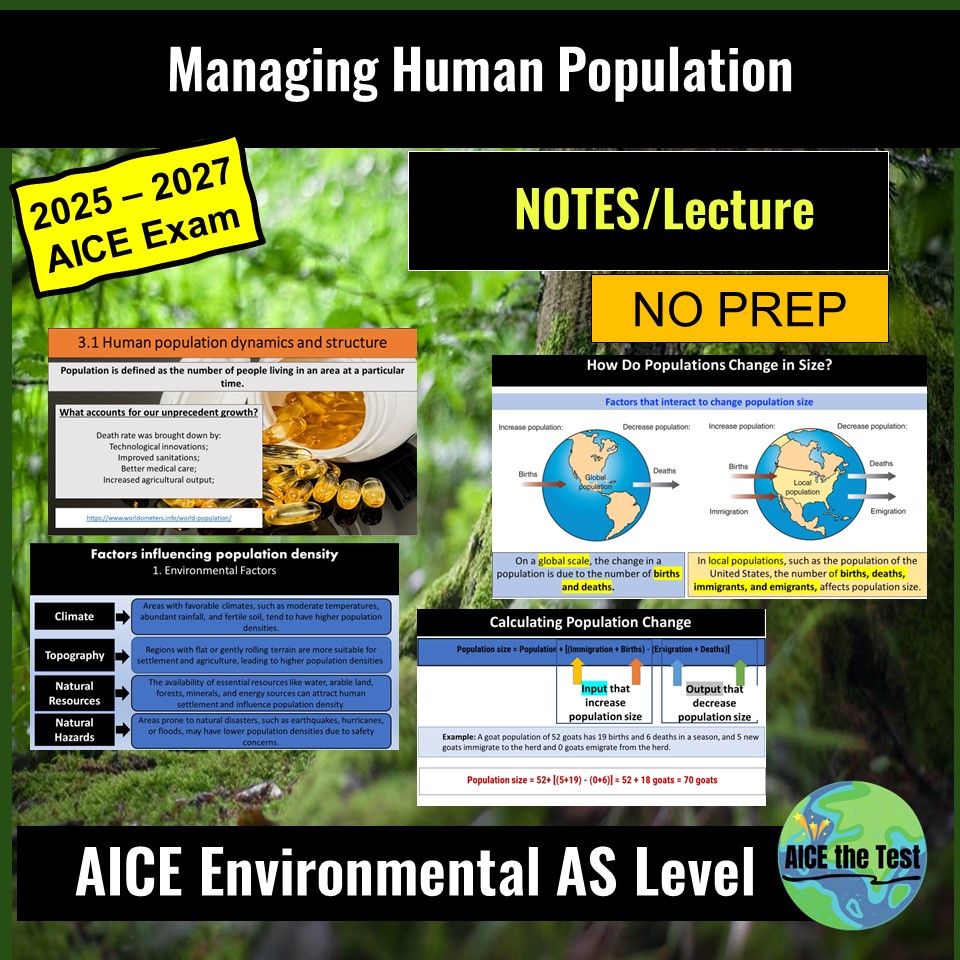
Human population dynamics and structure
The lesson plan focuses on teaching AICE Environmental Management, emphasizing human population dynamics, factors affecting distribution, and supporting students in calculating population density effectively.

3. Managing Human Population
Categorise
- 1. Introduction to Environmental Management
- 2. Environmental Research and Data Collection
- 3. Managing Human Population
- 4. Managing Ecosystems and Biodiversity
- 5. Managing Resources
- 6. Managing Water Supplies
- 7. Managing the Atmosphere
- 8. Managing Climate Change
- AICE Environmental Exam Prep
- AICE Environmental Management
- AICE Marine Exam Preparation
- AICE Marine Science AS
- Chapter 0 Practical Skills
- Chapter 1 Water
- Chapter 2 Earth Processes
- Chapter 3 Interactions in Marine Ecosystems
- Chapter 4 Classification and Biodiversity
- Chapter 5 Examples of Marine Ecosystems
Recent Posts
- QUIZ Unit 1 Introduction to Environmental Management
- AICE Marine Science AS Chapter 4 Classification and Biodiversity Day 5

- Key Groups of Marine Organisms – AICE Marine Science AS

- AICE Marine Science AS Chapter 4 Classification and Biodiversity Day 3

- AICE Marine Science AS Chapter 4 Classification and Biodiversity Day 2

