
-
AICE Marine Science AS Chapter 4 Classification and Biodiversity Day 7
This blog post offers strategies for teaching AICE Marine Science, focusing on ecosystems, habitats, and biotic/abiotic factors. It includes lesson objectives, materials, and activities like “Mystery Marine Ecosystem” and small group tasks. The post emphasizes interactive teaching methods to enhance student understanding and exam success. The homework involves transcribing lecture notes for active engagement in…
-

AICE Marine Science AS Chapter 4 Classification and Biodiversity Day 8
The blog post discusses effective teaching strategies for AICE Marine Science, focusing on population and sampling techniques. It covers the mark-release-recapture method, random and systematic sampling, Simpson’s index of diversity (D), and Spearman’s rank correlation (rs) for analyzing ecological data. The lesson plan includes hands-on activities, practice questions, and real-world examples to enhance understanding and…
-

AICE Marine Science AS Chapter 4 Classification and Biodiversity Day 6
This content offers a lesson plan for teaching AICE Marine Science, emphasizing the importance of marine biodiversity. It provides strategies to engage students and enhance their understanding of biodiversity levels and benefits. The lesson involves a hook, instruction on biodiversity levels and importance, small group activities, and an exit ticket. Students are assigned note transcription…
-

AICE Marine Science AS Chapter 3 Interactions in Marine Ecosystems Day 6
This blog post provides effective teaching methods for AICE Marine Science teachers to improve student understanding and exam performance in nutrient cycles and the carbon cycle. It includes objectives, materials, vocabulary, lesson outline, and homework suggestions. Strategies involve interactive activities, lecture, small group activities, and exit tickets to engage students and enhance learning outcomes.
-

AICE Marine Science AS Chapter 3 Interactions in Marine Ecosystems Day 5
This lesson plan focuses on teaching the chemical elements and biological roles of carbohydrates, lipids, and proteins in marine organisms. It includes engaging activities like “Molecular Models Mystery” and a case study on the importance of salmon to tree growth. The goal is to help students succeed in AICE Marine Science exams through interactive and…
-
AICE Marine Science AS Chapter 3 Interactions in Marine Ecosystems Day 4
In this blog post, AICE Marine Science teachers can learn strategies to teach ecological pyramids effectively. The lesson plan includes activities like “Building a Food Web” to engage students, clear lectures with visual aids, and incorporating real-world examples. Efficient homework strategies are also provided to optimize class time for engaging activities and in-depth understanding.
-
AICE Marine Science AS Chapter 3 Interactions in Marine Ecosystems Day 3
In this blog post, we explore effective strategies to enhance teaching methods for AICE Marine Science, focusing on energy transfer and energy losses in food chains. Activities like “The Great Energy Race” and engaging with visual aids and real-world examples help students better understand these crucial concepts. Incorporating these strategies can lead to higher passing…
-

AICE Marine Science AS Chapter 3 Interactions in Marine Ecosystems Day 2
This blog post provides strategies for AICE Marine Science teachers to effectively teach productivity, photosynthesis, chemosynthesis, and cellular respiration. It emphasizes the importance of foundational concepts and offers instruction, materials, and practical activities. By employing various teaching methods, teachers can ensure students are well-prepared for their exams and future marine biology studies.
-

Interactions in Marine Ecosystems: Parasitism, Commensalism, Mutualism
The lesson plan focuses on marine ecosystem interactions, emphasizing feeding relationships and symbiotic types like parasitism, commensalism, and mutualism.
-

AICE Marine Science AS Chapter 2 Earth Processes Day 9
The lesson plan for Chapter 2 Earth Processes Day #8 focuses on tectonic processes, weathering, erosion, sedimentation, and tides. It includes assessment, vocabulary, bellringer, instruction, case study on tsunamis, exit ticket, and homework to enhance learning outcomes in preparation for exams.
-

Ocean currents, Upwelling and El Nino
The lesson plan emphasizes teaching ocean processes like currents and ENSO, aiming to enhance AICE Marine Science students’ understanding and exam success.
-

Review Chapter 2 Earth Processes
This lesson plan focuses on enhancing AICE Marine Science exam success through targeted review of key concepts, exam strategies, and collaborative learning.
-

Tides: Spring tides and Neap tides
The lesson plan focuses on teaching tides, their formation, influences, and interpretation, enhancing AICE Marine Science students’ exam success through engaging methods.
-

The morphology of rocky shores, sandy shores, muddy shores, estuaries and deltas
AICE Marine Science lesson focuses on teaching weathering, erosion, sedimentation, and littoral zones to improve student exam performance.
-

Weathering, erosion, and sedimentation
The lesson plan focuses on teaching weathering, erosion, and sedimentation in AICE Marine Science, utilizing effective strategies, practical activities, and comprehensive notes to enhance student understanding and exam success.
-

AICE Marine Science AS Chapter 2 Earth Processes Day 2
This post discusses the importance of teaching tectonic processes and their impact on oceanic and geological landscapes in AICE Marine Science. It covers objectives, materials, vocabulary, lesson outline, interactive simulation, small group activity, practice questions, and homework, aiming to make complex concepts accessible and engaging for students while fostering deeper appreciation of Earth’s geological wonders.
-
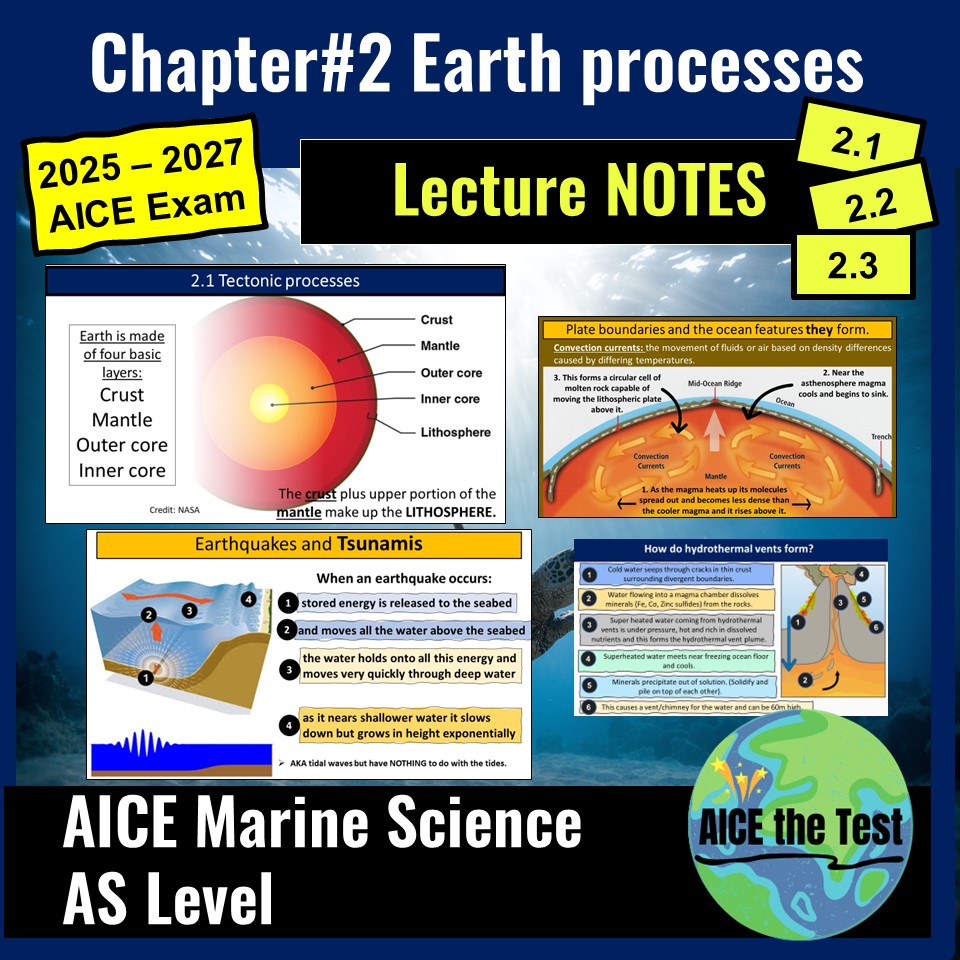
Tectonic processes: The structure of Earth’s interior, plate tectonics and plate boundaries
The lesson plan focuses on Earth’s structure and plate tectonics for AICE Marine Science, covering concepts, processes, evidence, and the classification of plate boundaries to enhance student understanding.
-
Day#8 Agenda – Unit#2 Environmental research and data collection
The goal of this lesson is to review the different sampling techniques by practicing Cambridge style questions and understand how data is collected and analyzed using a simulation for Simpson’s index of diversity. Day eight agenda covers the following objectives of section 2.4 Data collection techniques and data analysis: 1. Warm-up: Describe a sampling technique…

AICE the Test
Categorise
- 1. Introduction to Environmental Management
- 2. Environmental Research and Data Collection
- 3. Managing Human Population
- 4. Managing Ecosystems and Biodiversity
- 5. Managing Resources
- 6. Managing Water Supplies
- 7. Managing the Atmosphere
- 8. Managing Climate Change
- AICE Environmental Exam Prep
- AICE Environmental Management
- AICE Marine Exam Preparation
- AICE Marine Science AS
- Chapter 0 Practical Skills
- Chapter 1 Water
- Chapter 2 Earth Processes
- Chapter 3 Interactions in Marine Ecosystems
- Chapter 4 Classification and Biodiversity
- Chapter 5 Examples of Marine Ecosystems
Recent Posts
- QUIZ Unit 1 Introduction to Environmental Management
- AICE Marine Science AS Chapter 4 Classification and Biodiversity Day 5

- Key Groups of Marine Organisms – AICE Marine Science AS

- AICE Marine Science AS Chapter 4 Classification and Biodiversity Day 3

- AICE Marine Science AS Chapter 4 Classification and Biodiversity Day 2

