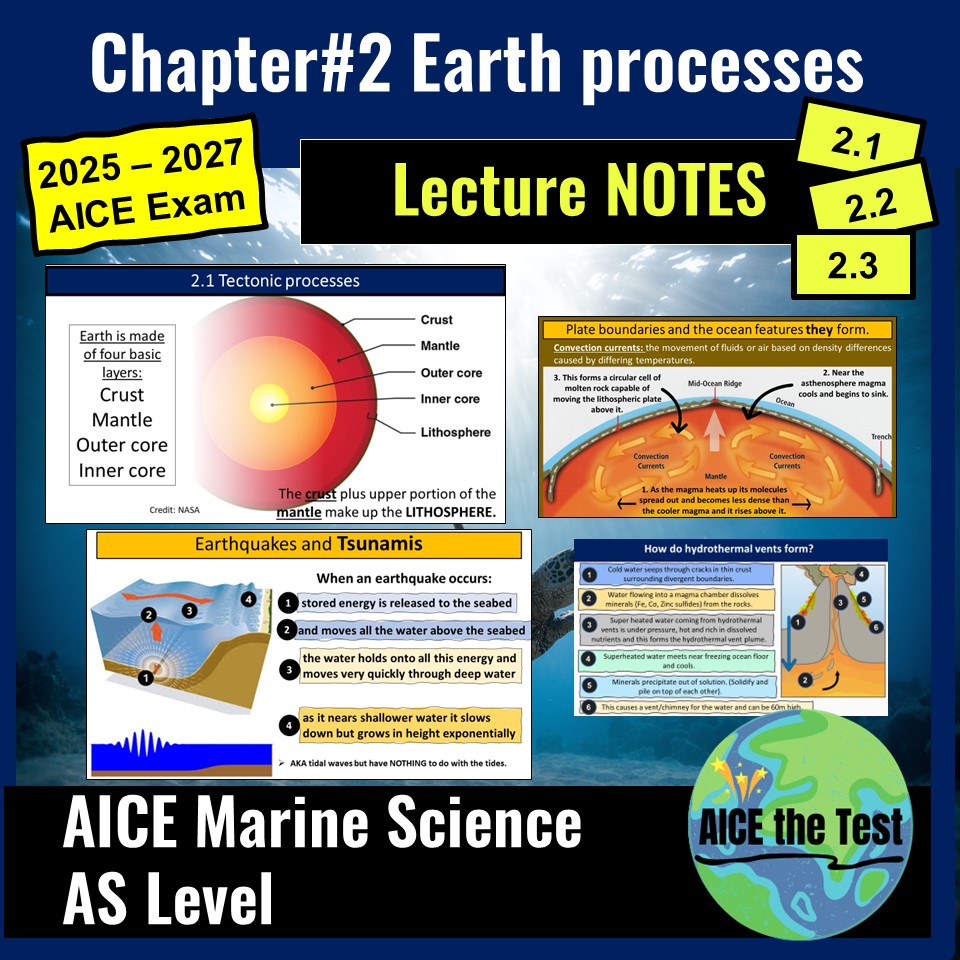

Chapter 2 Earth Processes Day#1. Lesson plan
Exploring Earth’s Structure and Plate Tectonics: Essential Concepts for AICE Marine Science Exam
As educators in AICE Marine Science, understanding Earth’s structure and the theory of plate tectonics is fundamental for teaching key geological processes that shape our planet. This blog post delves into these foundational concepts, providing insights into Earth’s composition, the theory of plate tectonics, supporting evidence, and the classification of plate boundaries.
Objectives
- 2.1 Tectonic processes
- describe the structure of the Earth
- describe the theory of plate tectonics, and the evidence supporting the theory
- identify and describe the three types of plate boundary as convergent, divergent and transform
Materials
Vocabulary
- Crust: the outermost layer of rock on Earth
- Mantle: a region of molten rock within the interior of the Earth, between the core and the crust
- Core: the dense, central region within Earth
- Oceanic crust: the dense, basaltic layer of crust that makes up the bottom of the ocean basins
- Continental crust: the thicker, less dense crust that makes up the foundation of the continents
- Continental drift: a theory supporting the possibility that continents are able to move over Earth’s surface
- Plate tectonics: the process where large sections (plates) of the Earth’s crust are in constant movement over the fluid mantle, causing earthquakes and volcanoes at the borders between the plates
- Lithosphere: the outermost layer of the Earth’s crust
Bellringer
- Bellringer#1
- Alternative: Describe the internal structure of Earth.
Lesson Outline
Instruction
- Bell Ringer #1
- Lecture/Notes (PPT – slides 1-13 )
- Explain the theory of plate tectonics, including:(PPT – slides 6 – 7 )
- How the lithosphere is divided into plates.
- Mechanisms driving plate movement (e.g., convection currents in the mantle).
- Discuss the historical development of the theory and key scientists involved.
- Present evidence supporting plate tectonics: (PPT – slides 7 – 8 )
- Fit of continents (Pangaea).
- Paleomagnetism and magnetic reversals.
- Seafloor spreading and mid-ocean ridges.
- Distribution of earthquakes and volcanic activity.
- Introduce the three types of plate boundaries: (PPT – slides 9 – 12 )
- Convergent Boundaries: Discuss oceanic-continental, oceanic-oceanic, and continental-continental collisions and resulting geological features (e.g., trenches, mountains).
- Divergent Boundaries: Explain seafloor spreading at mid-ocean ridges and formation of new crust.
- Transform Boundaries: Describe horizontal plate movements, focusing on earthquake activity (e.g., San Andreas Fault).
- Show videos or simulations demonstrating plate movements and boundary interactions. Below is a great video Credit: IRIS Earthquake Science
- Explain the theory of plate tectonics, including:(PPT – slides 6 – 7 )
- Review and Recap
- Summarize key points about Earth’s structure, plate tectonics, and plate boundaries.
- Clarify any remaining questions or misconceptions.
- Practice/Review plate boundaries – (PPT – slide 13 )


- Small group activity
- Divide students into small groups.
- Assign each group a plate boundary
- Have groups research real world examples including geographic location, the movement of plate tectonics, the features the movement forms and the impact the movement has on marine environments and urban areas
- Have groups present their findings to the class.
Layers of the Earth and Pangea – Diagram and AICE practice Q’s

Have students complete the fill-in diagrams using their notes or textbook. These labeling activities reinforce essential terminology and help students visualize concepts such as the Earth’s internal structure, paleomagnetism, and continental drift.
Once the diagrams are complete, students apply their knowledge by answering the accompanying AICE-style questions. These questions require students to interpret evidence, analyze diagrams, and explain scientific concepts using Cambridge command words and exam expectations.
After students finish, review the included answer key as a class. Discuss common misconceptions, model high-quality responses, and reinforce the scientific vocabulary expected on the AICE examination.
- Exit ticket
- If you opt to have students complete their notes using the Student Guided Notes format during your lecture, then use the bellringer as the exit ticket activity in class.
- If you opt to have students complete their notes using the Student Guided Notes format at home (homework), then use the following exit ticket activity:
- Describe the movement of plate tectonics at convergent boundaries.
By integrating these strategies into your teaching, you can help students grasp the complexities of Earth’s structure, plate tectonics, and their profound impact on shaping our planet’s geology and marine ecosystems. These foundational concepts are crucial for their success in AICE Marine Science and their understanding of Earth’s dynamic processes.
Homework
- The sole homework task assigned to my students revolves around meticulously transcribing notes in the Student Guided Notes format. They meticulously replicate content by hand from the Lecture/Notes (PPT – slides 14 – 21 ) presentation.
- This approach ensures that during class time, while I continue to deliver lectures and expound on topics, students have their notes already compiled. Consequently, they can actively engage, ask questions, and delve deeper into understanding rather than merely being preoccupied with note-taking. This strategy efficiently liberates valuable class time, allowing for engaging activities and practice Cambridge style questions.
More lessons…


Leave a Reply