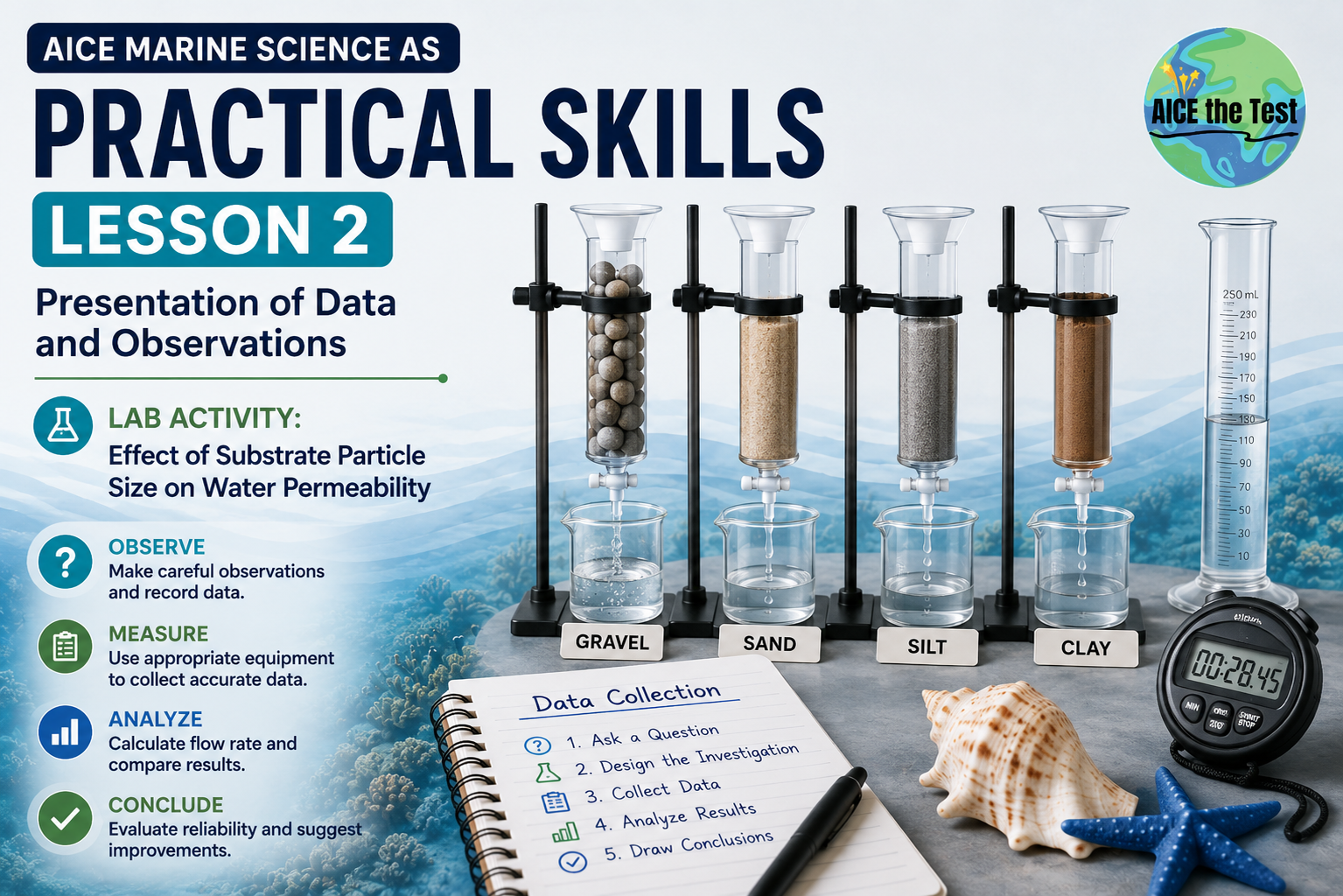

AICE Marine Science AS
Practical Skills
Lesson 02: Presentation of Data and Observations
📖 Introduction
In this lesson, students apply the principles of experimental design by conducting a practical investigation and collecting scientific data. They learn how to use appropriate equipment to obtain accurate measurements, record qualitative and quantitative observations, and recognize the importance of controlling variables to ensure reliable results. Through the Effect of Substrate Particle Size on Water Permeability investigation, students gain hands-on experience with the practical skills required for laboratory work and the Cambridge AICE Marine Science examination. This lesson reinforces good scientific practice while developing confidence in data collection and observation techniques.
📘 Cambridge Syllabus Alignment
0.1 Steps of experimental design
- Steps of an experiment
- Qualitative and quantitative data
0.2 Presentation of data and observations
- Using the correct equipment to take measurements during an experiment
- Choosing the appropriate techniques to control key variables during an experiment
- How to determine the number of measurements and observations during an experiment
🎯 Students Will Be Able To:
- Apply techniques to control variables and improve the reliability of experimental results.
- Collect and organize experimental data in a clear and systematic format.
- Evaluate the importance of repeated measurements and observations for improving data reliability.
- Follow safe laboratory procedures while conducting a scientific investigation.


Lesson Timeline
| Time | Activity |
|---|---|
| 10 min | Bell Ringer – Review experimental design concepts and introduce the investigation. |
| 10 min | Pre-Lab Discussion – Demonstrate the experimental setup, explain the data table, identify independent, dependent, and controlled variables, and answer student questions. |
| 40 min | Laboratory Investigation – Students complete the Effect of Substrate Particle Size on Water Permeability investigation, collect measurements, and record qualitative and quantitative observations. |
| 20 min | Data Analysis & Class Discussion – Students organize their results, compare findings, evaluate sources of error, and discuss the reliability of the data collected. |
| 10 min | Exit Ticket & Cleanup – Students submit a brief reflection or analysis question, clean workstations, and prepare materials for the next lesson. |
Resources Used


💡 Teacher Tips
- Pre-label each substrate (gravel, sand, silt, and clay) and organize materials at each lab station to maximize investigation time.
- Model one complete trial, including how to pour the water, start the stopwatch, and record observations.
- Remind students that every group must use the same substrate depth, water volume, compaction method, and head height to ensure a fair test.
- Designate a Timer, Recorder, Materials Manager, and Investigator so every student participates.
- Students should record both quantitative data (time and flow rate) and qualitative observations (water clarity, air bubbles, channeling, or sediment movement).
- Check that students are not changing more than one variable during the investigation.
- Combine results from all groups to calculate class averages and discuss natural variation between trials.
- Encourage students to identify outliers, compare repeated trials, and explain why multiple trials improve confidence in the results.
- Emphasize that identifying variables, evaluating methods, interpreting data, and suggesting improvements are common skills assessed on Cambridge AICE Marine Science Paper 2.
⭐ Common Student Mistakes
- Pouring the water too slowly or inconsistently.
- Forgetting to start or stop the stopwatch at the correct time.
- Compacting different substrates with different amounts of force.
- Recording only measurements and forgetting qualitative observations.
- Confusing permeability with porosity.
- Failing to identify controlled variables in the lab report.
⚠️Common Misconceptions
Larger particles always hold less water.
Clarify that permeability (how easily water moves through a material) is different from porosity (the amount of pore space). A material can have high porosity but relatively low permeability if its pore spaces are poorly connected. This distinction is frequently assessed in AICE practical questions.
- Gravel: Large, well-connected pores → high permeability
- Sand: Medium, well-connected pores → high to moderate permeability
- Silt: Small pores → low permeability
- Clay: Very tiny pores that are poorly connected and strongly hold water → very low permeability
🌟 Differentiation
ELL (English Language Learners)
- Pre-teach key vocabulary (e.g., permeability, substrate, qualitative data, quantitative data, variable, trial).
- Provide a visual diagram of the experimental setup before beginning the investigation.
- Pair students with supportive peers during the laboratory activity.
- Encourage the use of sentence starters when discussing results (e.g., “The permeability of ____ was higher because…”).
ESE / Students Requiring Additional Support
- Provide a partially completed data table or sample trial for reference.
- Read laboratory instructions aloud and demonstrate each step before students begin.
- Assign structured group roles (Recorder, Timer, Materials Manager, Investigator).
- Allow extended time for data collection, graphing, and analysis if needed.
Enrichment / Advanced Learners
- Ask students to calculate the percentage difference in permeability between substrates.
- Have students evaluate potential sources of error and suggest improvements to increase reliability.
- Encourage students to compare permeability with porosity and explain why the two properties are not always the same.
Exit ticket
- If you opt to have students complete their notes using the Student Guided Notes format during your lecture, then use the bellringer as the exit ticket activity in class
- If you opt to have students complete their notes using the Student Guided Notes format at home (homework), then use the following exit ticket activity: Example page 191-192 (Marine Science Coursebook)
Homework – high level/flipped classroom
- Student Guided Notes
- Version A – For High-Level Students:
Ideal for independent or advanced learners, this version requires students to copy all notes by hand as homework before class. This flipped-learning approach helps students come to class prepared, freeing up time for application activities, discussions, and AICE-style practice questions. - For this assignment have students fill in the blanks using the PPT Presentation. The Guided Notes can be found HERE. See few pages below.
- Version A – For High-Level Students:
More lessons…


Leave a Reply