

Practical Skills Day #8. Lesson plan
Enhancing Marine Science Education with Spearman’s Rank Correlation
Understanding the intricate relationships between different variables in marine environments is crucial for students studying marine science. Spearman’s Rank Correlation is a valuable statistical tool that helps in analyzing these relationships, offering insights into how one variable might influence another. In this lesson, students will learn not only how to calculate Spearman’s Rank Correlation but also how to interpret the results, fostering a deeper understanding of marine ecosystems. The lesson plan is designed for high school students and spans a 90-minute block period.
Objectives
- Using Spearman’s rank of correlation
- Interpret the results of Spearman’s rank of correlation
Vocabulary
- Spearman’s rank correlation: a mathematical tool used to find out if there is a correlation between two sets of variables, when they are not normally distributed
- Null hypothesis (H.): there is no correlation between the two sets of variables
- Critical values of r: indicate when the calculated Spearman’s rank is sufficient to suggest a correlation between the two sets of variables
- Alternative hypothesis: there is a significant correlation between two sets of variables
Bellringer
- Bell ringer#8
- Alternative: Describe the characteristics of an ecosystem having a diversity index D close to 1.
Lesson Outline
- How Ocean Acidification Affects Marine Organisms-cont. (15 minutes)
- Students will conduct observations, pH measurement and record shell weight for control and experimental group.
- Students will record all data and observations.
- Begin with Bell ringer#8
- Lecture/Notes (PPT – slides 42 – 46)
- Students will learn about different types of correlations and their significance. The formula for Spearman’s Rank Correlation is introduced and explained in detail, ensuring students grasp the mathematical foundation of the concept.
- Define correlation and its importance in science. Differentiate between positive, negative, and no correlation.
- Present the formula for Spearman’s Rank Correlation and explain each term.
- Walk through a sample calculation using a simple data set. – slide 43-45
- Discuss how to interpret the resulting value – slide 46
- Below are slides 42-44


- Use Student Guided Notes – This year, I’m using Version B Guided Notes with my students, as I’ve noticed they benefit from having more structured support during class.
- It features fill-in-the-blank prompts for key vocabulary and concepts, making notetaking faster and more accessible, especially for English language learners or those with processing difficulties.
- Small group activity and Individual practice.
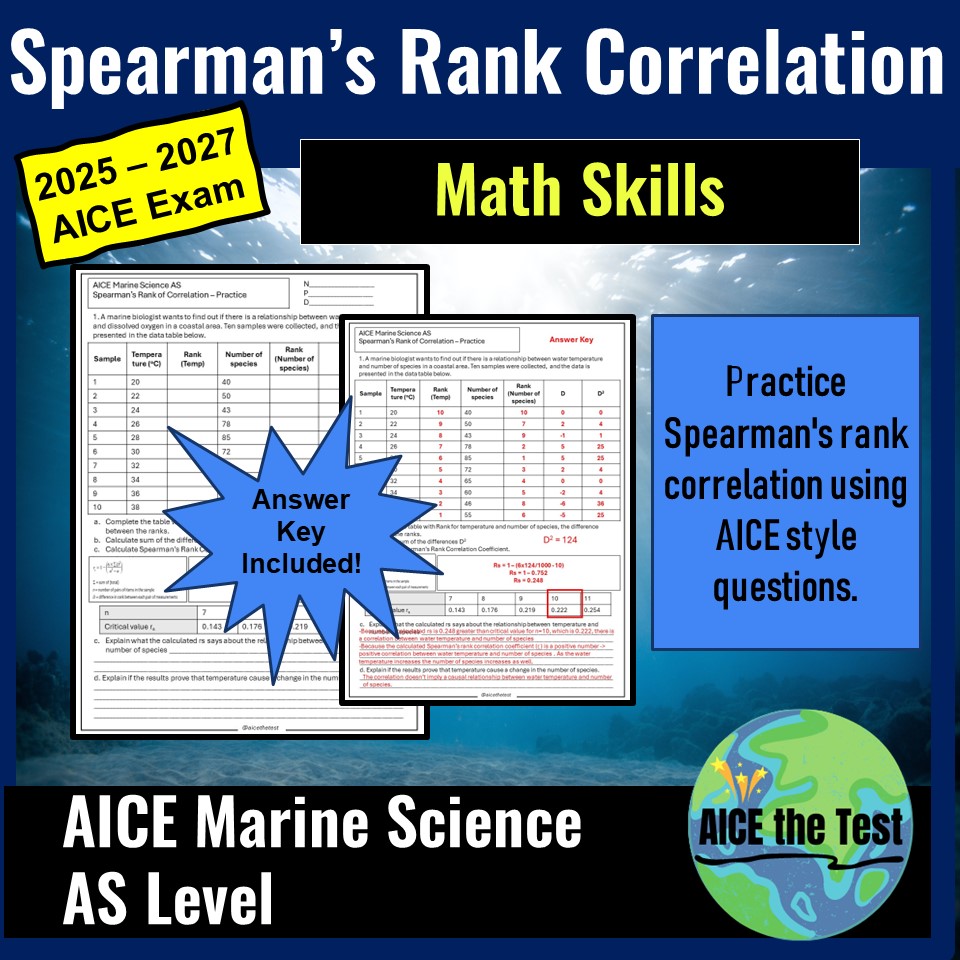
- Students will work in groups (2-3 students) to calculate Spearman’s Rank Correlation using Math Skills 4.3 page 139 – 142 (Coursebook).
- This hands-on activity encourages collaboration and critical thinking.
- Following this, they will individually calculate the correlation for a new data set, reinforcing their understanding and application of the concept. You can find the activity HERE.
- Students will share their results and interpretations with the class, fostering a collaborative learning environment. The discussion will highlight how different factors can affect the correlation and what the results imply about the marine ecosystem being studied.
- Exit ticket
- If you opt to have students complete their notes using the Student Guided Notes format during your lecture, then use the bellringer as the exit ticket activity in class.
- If you opt to have students complete their notes using the Student Guided Notes format at home (homework), then use the following exit ticket activity:
- Exam-style questions – Page 147, Question 6 (Coursebook)
This lesson on Spearman’s Rank Correlation is a vital addition to the marine science curriculum. It equips students with the tools to analyze and interpret complex data, enhancing their understanding of marine ecosystems. By engaging in both collaborative and individual activities, students develop critical thinking and problem-solving skills that are essential for the AICE Marine Science Exam. Through this lesson, we aim to inspire and prepare students to tackle the challenges of the AICE examination.
Homework
- Students will review Practical Skills concepts and prepare for chapter assessment.
More lessons…


One response to “Mastering Spearman’s Rank Correlation in Marine Science: Analyzing Variable Relationships”
keen! Global Vertical Farming Industry Expands 2025 cute