
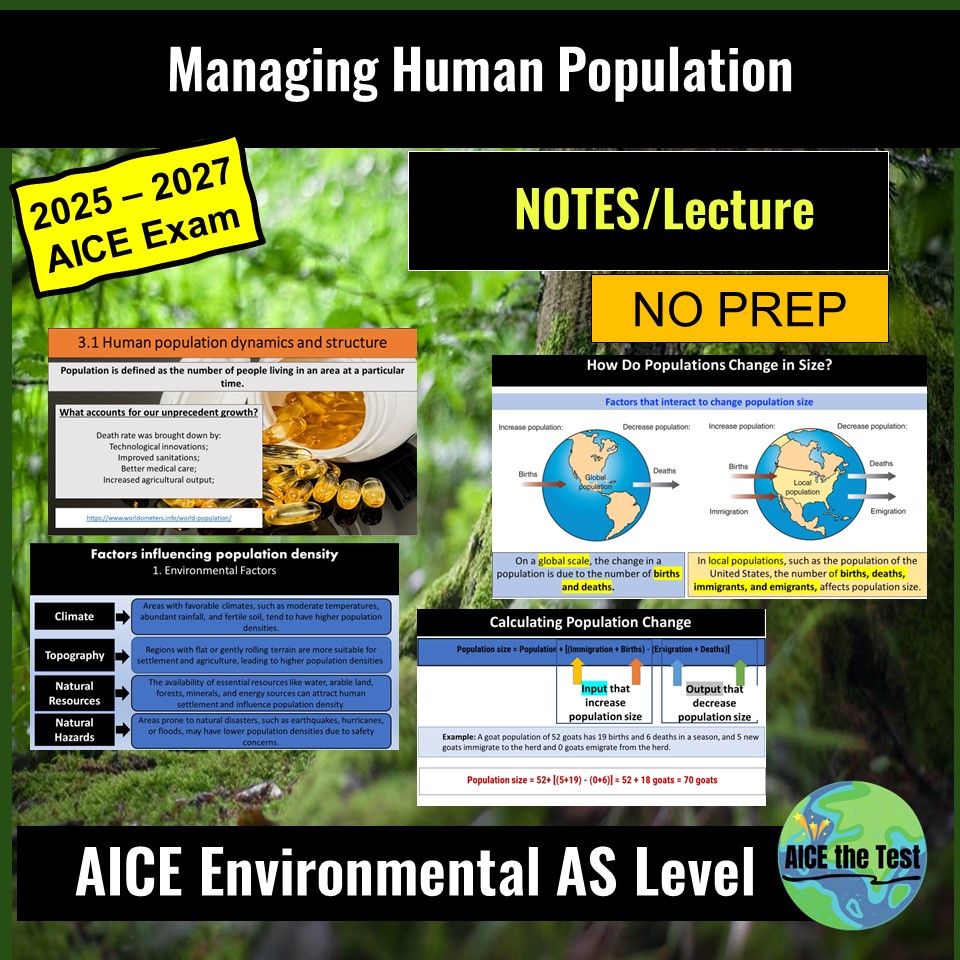

3. Managing Human Population Day#1. Lesson plan
Effective Strategies for Teaching AICE Environmental Management: Boosting Exam Success
As an AICE Environmental Management teacher, you are constantly seeking ways to enhance your teaching methods and improve your students’ exam success rates. One of the key areas of the curriculum involves understanding the factors influencing population density and distribution, as well as calculating population density from given data. Here’s a detailed guide to help you achieve these objectives, complete with a captivating lesson hook.
Objectives
- 3.1 Human population dynamics and structure
- describe and explain factors influencing population density and distribution
- calculate population density from given data
Vocabulary
- Migration: the movement of peoples from one place in the world to another.
- Primary industry: industry such as mining, agriculture, fishing or forestry that involves harvesting raw materials.
- Secondary industry: industry that converts raw materials such as farming or mining products into products for sale. The manufacturing industry.
- Out-migration: to leave one community or area in order to settle in another area.
- In-migration: to move into an area or region in order to settle down and live.
- Push factors: these are factors that cause people to move from an area. They include war, brought, flood, lack of housing, food, education, and lack of jobs or a poor standard of living.
Bellringer
- Bell ringer #1
- Alternative: What are some cause of migration?
Lesson Outline
Hook
- Have students read and answer discussion questions – Environmental management in Context – The North Sentinel Islanders: people in balance with their environment – page 109 (Coursebook)
Instruction
- Bell ringer #1
- Lecture/Notes – Lecture (Chapter 3 PPT – slides 1- 15)
- Initiate a discussion on the various factors influencing population density and distribution, such as geographical features, climate, resource availability, and human activities. Use real-world examples and case studies to illustrate these points.
- Utilize Lecture (Chapter 3 PPT – slides 1- 15) to visually present how different factors affect population distribution. Show contrasting examples, such as densely populated urban areas versus sparsely populated rural regions.
- Provide clear, step-by-step instructions on how to calculate population density. Use simple formulas and walk through several examples to ensure students grasp the concept.


- Use Guided Notes – This year, I’m using Version B Guided Notes with my students, as I’ve noticed they benefit from having more structured support during class.
- It features fill-in-the-blank prompts for key vocabulary and concepts, making notetaking faster and more accessible, especially for English language learners or those with processing difficulties.
- Individual activity
- Exit ticket
- If you opt to have students complete their notes using the Student Guided Notes format during your lecture, then use the bellringer as the exit ticket activity in class.
- If you opt to have students complete their notes using the Student Guided Notes format at home (homework), then use the following exit ticket activity:
- Case Study: Population distribution case Study: conflict in South Sudan – page 114 – 115
By implementing these strategies, you can create a dynamic and effective learning environment that not only enhances your students’ understanding of population density and distribution but also significantly boosts their performance in the AICE Environmental Management exam. Engage your students with captivating lesson hooks, provide hands-on practice, and continuously assess their progress to ensure they are well-prepared for success.
Homework – high level/flipped classroom
- Version A – For High-Level Students:
Ideal for independent or advanced learners, this version requires students to copy all notes by hand as homework before class. This flipped-learning approach helps students come to class prepared, freeing up time for application activities, discussions, and AICE-style practice questions. - For this assignment have students fill in the blanks using the PPT Presentation.
More lessons…


